A portfolio career is a working life built from several income streams instead of one employer. Each stream draws on the same core expertise: a fractional or part-time role, advisory work, consulting, coaching, a board seat, teaching or speaking.
For most of the last century, a good career meant one employer, one title and one payslip. It felt safe. In practice, it concentrates all your risk in one place. A restructure, a new boss or a single email can stop your income overnight, however good you are at your job.
A portfolio career spreads that risk. It doesn’t mean doing lots of unrelated things. It means taking the expertise you’ve built over ten or twenty years and offering it to more than one buyer, in more than one form.
You can keep your full-time job
This is the part most people get wrong. A portfolio career is not a holding pattern before you resign, and it isn’t a runway for quitting. For many people, the full-time job stays at the centre of the portfolio, permanently, with one or two other streams built around it.
That’s the point. Your job keeps paying the bills and keeps your expertise current. The other streams make sure it’s never your only option. If your role changes, shrinks or disappears, you already have clients, credibility and income elsewhere. If it doesn’t, you simply have a richer, safer career.
Whether you ever leave is a separate decision, and you don’t have to make it. A portfolio career works just as well if you never do.
“I don’t have the time.” You decide how much.
The first worry most people raise is that this will swallow every evening and weekend. It doesn’t have to. A portfolio career runs at the pace you set: one advisory client a quarter, a talk twice a year, half a day a month on a board. You choose how much time it takes, and you can change your mind.
What makes it manageable is that every stream draws on expertise you already have. You aren’t learning a new trade at night; you’re offering what you already know, in a different form. Decide the hours first, protect them in your week, and let the portfolio fit around them, not the other way round.
It doesn’t have to take all your time
The first worry most people have is time: “I already have a full-time job. When would I do this?” The honest answer is that you decide. A portfolio career doesn’t come with a fixed number of hours. You set the pace, the scope and how much of your week each stream gets.
For some people that means one advisory client and a few hours a month. For others it’s a fractional role one day a week. Both are portfolio careers. Starting small isn’t a compromise; it’s how you test what works without burning out or putting your job at risk.
What matters is designing your week on purpose, before it fills up on its own, and reviewing it every quarter so you can add, cut or slow down.
A portfolio career is not a side hustle
The terms get mixed up, but they describe very different things.
The difference is design. In a portfolio career, a board role makes you more credible as an adviser, advisory work gives you material for speaking, and speaking brings in clients. The streams reinforce one another instead of competing for your time.
What a portfolio career can include
- Your current job, full-time or part-time. For many people it stays the anchor of the portfolio for good.
- Fractional roles: a senior role for one or two days a week, such as a fractional CFO, CMO or HR director.
- Advisory and consulting: solving a specific, defined problem for a client, on a project or retainer.
- Non-executive and board roles: governance, oversight and strategic counsel.
- Coaching and mentoring for people a few steps behind you.
- Teaching, writing and speaking: workshops, courses, keynotes and books.
Who is a portfolio career for?
It works best when you have something specific and valuable to offer. It tends to suit you if:
- You’re a decade or more in, with real expertise trapped inside one job title
- You’re a senior leader weighing fractional, advisory or board work
- You already consult independently, but want it to feel less precarious
- You have deep expertise and little visibility outside your organisation
- You’re returning after a break and want to rebuild on your own terms
It’s probably not for you if you want a simple, linear ladder inside one organisation, a few hundred extra a month without changing anything, or permission to quit tomorrow.
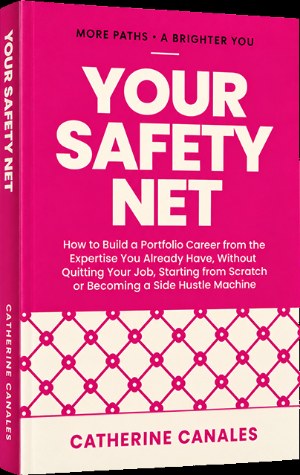
Your Safety Net is the step-by-step guide to building a portfolio career. I’m looking for early readers to read the draft and help shape the final book.
How to build a portfolio career alongside your job
You don’t need to resign, now or later, and you don’t need to start from scratch. A portfolio career runs in parallel with your full-time role, built one deliberate step at a time.
- Find where your risk is concentrated. List where your income, reputation and relationships come from. If the answer to all three is your employer, that’s the risk to reduce.
- Stop describing yourself by your job title. Audit what you actually know and do well, beyond the title. That expertise is what you have to offer.
- Turn expertise into a problem people pay to solve. Swap “What can I do?” for “What specific problem can I solve for a client?”. Then test it with real buyers before you build anything.
- Design an offer someone can say yes to. A clear scope, a clear outcome and a price, ready to send, not invented on the call.
- Become findable. Be known for one specific thing by the right people. You don’t need to become a full-time content creator; consistent visibility and warm relationships do most of the work.
- Build your safety net before you need it. Read your employment contract, get approvals in writing, and set aside six to twelve months of essential costs.
- Design your week before it fills up. Protect time for each stream, and for recovery, or the busiest one will take over.
- Review, prune and evolve. Every quarter, keep what works, drop what doesn’t and add the next stream.
Are you ready? Nine questions to ask yourself
The Portfolio Career Scorecard from the book measures readiness across nine areas. Score yourself from 1 to 5 on each:
- Clarity: can you say what you do, for whom, in a way a stranger would remember?
- Demand: have real buyers confirmed the problem is worth paying to fix?
- Offer readiness: could someone say yes to a clear, priced offer today?
- Visibility: are you known for something specific, by the right people?
- Relationships: do you keep relationships warm before you need them?
- Financial runway: could you cover your essentials without new income?
- Time capacity: is your week designed, or does it fill up on its own?
- Risk management: are your contracts, approvals and protections in place?
- Evidence of traction: do you have current proof, not just plans?
Low scores aren’t a reason to stop. They show you where to start.
Score yourself in two minutes, see your results as a wheel, and download the printable version to repeat every quarter.
Frequently asked questions
Do I have to quit my job to start a portfolio career?
No, not to start and not later. A portfolio career can run in parallel with your full-time job indefinitely. Your role stays the anchor while you add one or two streams at a pace your contract, finances and week allow. It is a safety net, not a runway for quitting.
Can I have a portfolio career and a full-time job?
Yes. Many portfolio careers are built around a full-time job that stays at the centre permanently. The other streams draw on the same expertise and mean your employer is never your only option, whether or not you ever leave.
How much time does a portfolio career take?
As much as you decide. Some people give it a few hours a month alongside a full-time job; others build it up over time. Set the hours first, protect them in your calendar, and choose streams that fit, such as a single advisory client, an occasional talk or one board role.
How much time does a portfolio career take?
As much as you choose. There is no fixed number of hours. It can be a few hours a month with one client or a day a week in a fractional role. You set the pace and review it every quarter.
Is a portfolio career risky?
It changes the kind of risk you carry. One employer is a single point of failure; several streams mean losing one doesn’t stop everything. The real risks are a thin financial runway, unclear contracts and an overloaded week, and all three can be planned for.
How much financial runway do I need?
Aim for six to twelve months of essential costs set aside, plus a separate pot for tax and a simple income forecast, before you rely on new streams for a meaningful share of your income.
Is a portfolio career a good option for women?
Often, yes. Career breaks, caring responsibilities and slower promotion paths mean many women carry more concentration risk than they realise. A portfolio built on expertise gives you options that don’t depend on one organisation’s timeline. The book gives this a chapter of its own.
How long does it take to build a portfolio career?
Expect to build it in phases over one to three years: first clarity and proof, then a first paying stream alongside your job, then a portfolio that keeps working whatever happens to any one part of it. Moving faster usually means skipping the safety net.

Catherine Canales is the author of Your Safety Net, forthcoming in 2027, and writes Unboxed, a weekly newsletter on building a portfolio career. She’s based in Barcelona.